Category: NSW Government

Member for Goulburn Wendy Tuckerman visits Springdale solar site and meets with impacted residents

Our last post informed you about the NSW governments notion of embracing Social licence and how important they say it is to have community support and buy in for development in an area. We are yet to receive a response to the SSAG’s letter to Rob Stokes, NSW Minister for Planning and Public Spaces questioning why the Springdale solar development was approved with absolutely no social licence.

The Sutton Solar Action Group (SSAG) has continued to voice our concerns about the Independent Planning Commission’s (IPC) decision to approve the Springdale solar development and asked our local member Mrs Wendy Tuckerman, MP, Member for Goulburn to visit the area and see for herself what the impacts will be, especially visually.

As we all know Renew Estate and RES downplayed the visual impacts of the project on surrounding properties and completely ignored the impact on residents who live to the east of the site. On page 21 of the Department of Planning, Industry and Environment’s (DPIE) Assessment Report it states, ‘RES clarified that although the VIA did not provide a detailed assessment of all residences within 2 km of the site it considered that the residences not included would not have views of the project due to intervening topography.’ Its clear that whatever a developer says is taken as the truth, with no questions asked by the DPIE.  We also note that despite three separate versions of visual assessments there was no consensus on visual impacts on individual residences.

Below is DPIE’s map showing the 35 residences within 2km of the site. We selected three residences around the site for her visit, R2, R5 and R13 to show the views from different locations and angles.

Source: DPIE Springdale Solar Farm (SSD 8703) | Assessment Report page 21

To say Mrs Tuckerman was shocked at what she saw before her is an understatement. The sheer size of the solar development and where it sits at the bottom of a valley without the ability to be effectively screened was a total eye opener for Mrs Tuckerman. She also commented about how it is impossible to perceive these developments unless you actually visit these locations, and that a piece of paper with a map on it does not reflect the actualities of what is proposed.

We also drove Mrs Tuckerman along the proposed heavy vehicle traffic route along East Tallagandra Lane and through the village. Mrs Tuckerman was amazed that this route was chosen and raised concerns about its suitability, especially the causeway that crosses McLaughlins Creek.  
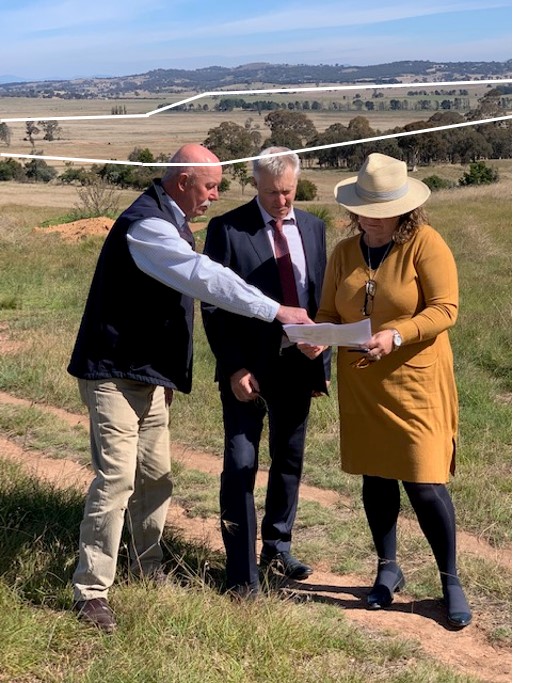
Sutton District and Community Association Inc. (SDCAI) President Mark Burgess (on the left) showing Mrs Tuckerman (on right) where this residence (R13) is located on figure 11. shown above and the extent of his view, i.e. the area inside the white line.

Much of the vegetation within the white lines will be removed to make way for solar arrays and shipping containers.

In the middle is the impacted resident John Brennan. John’s family place a high value on this view, representing as it does an essential and visible part of the biodiversity corridor that he has helped encourage by plantings of native trees and reductions in stocking rates on his property, which directly adjoins the proposed property.

DPIE claim they will not see the development because of topography and the proposed vegetation screening. FALSE

Rather than take the time to consider the objections raised by residents, DPIE blindly accepted RES’s claims.

No matter how much vegetation they plant, this development cannot be hidden because it is in the bottom of a valley.
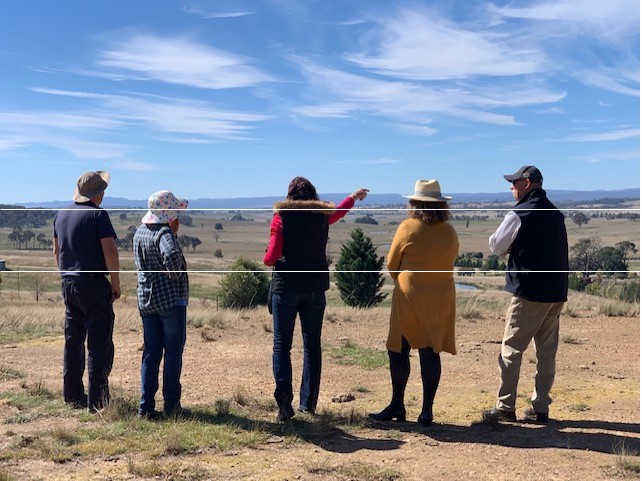
From left to right: residents of R5 and SSAG members, Dianne Burgess, Wendy Tuckerman and SDCAI President Mark Burgess

SSAG member Dianne Burgess (middle) showing Mrs Tuckerman (on her right) the extent of the Springdale development from another angle, this is what the residents of R5 will see. The entire development site can be seen from here, i.e. the area within the white lines. There is no possibility of this being screened.

Again, much of the vegetation within the white lines will be removed to make way for solar arrays and shipping containers.

The DPIE considers these residents will only be moderately impacted and that topography and proposed vegetation screening will hide the development.  FALSE
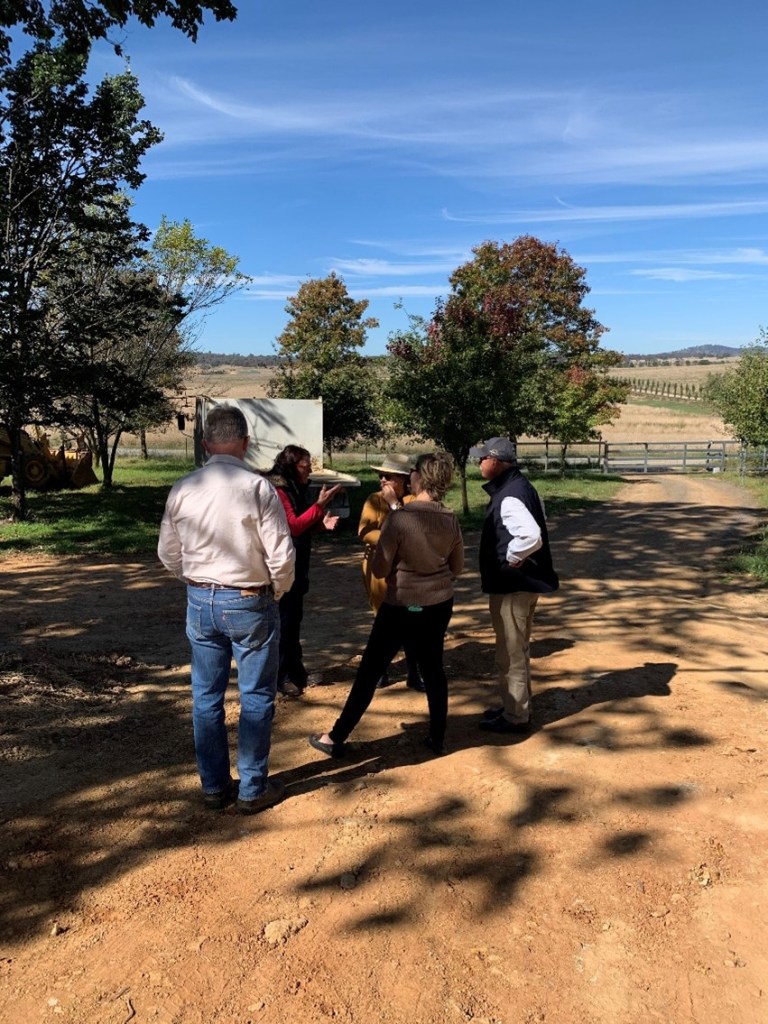
Mrs Tuckerman meeting with two of the landholders of Tintinhull Road, which divides the solar development into east and west sections.

R2 resident Jacqui Hassall’s (fourth from the left) property adjoins the development site and lives at the end of Tintinhull Road. Her family will have to pass through this development every day for 35 years should this development be built.

The landscape plan, which is still up for debate, with everyone except the impacted residents, has no provision to screen two thirds of Tintinhull Road and will also have at least a 2m high security fence around the solar array fields and run along either side of the road. It will be like driving through a minimum-security prison.

RES, the DPIE and the IPC believe this is an acceptable outcome. The DPIE even went as far as changing the visual impact assessment rating from high down to moderate.

Mark O’Shea (first on the left) owns 600 acres on Tintinhull Road. His property also adjoins the property and at one time thought about building on the site to take in the extensive views over the valley. All that would be seen now would be vast acres of solar arrays and shipping containers.
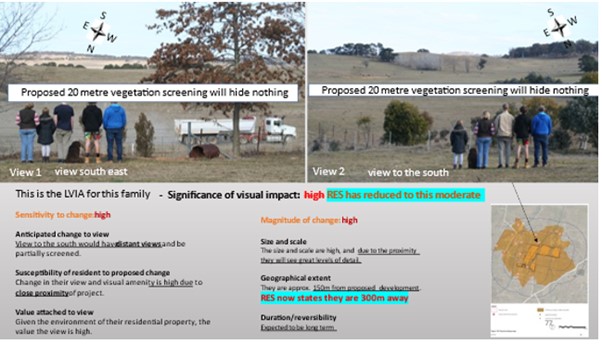
This is the Hassall’s family’s view over both sides of the development site. The white stripes on the images are the proposed 20m wide vegetation screenings. RES also changed their proximity to the development from 150m to 300m. A purely aribitrary decision by RES.

In the image on the left (above) the hill is at least 10-15m higher, so to screen out the infrastructure the vegetation will need to grow to at least 20m in height to provide a successful screen.

In the image on the right (above) the hills are at least 30-40m higher than where the family are standing. To provide an adequate vegetation screen the vegetation will need to grow to at least 40 or 50m. 

DPIE’s approval conditions state that a mature vegetation barrier is to be installed and maintained. What is determined as mature vegetation and how will the developer guarantee maintaining such a barrier?  How is it even possible to audit such a condition, what is the benchmark for this sort of thing, is there one?

The image above is from RES’s submission to the IPC for the Springdale solar assessment. This is their vision and how they see renewable energy developments being built, the DPIE and the IPC obviously support this view.  There is something fundamentally wrong if this is the vision that the planning authorities have for regional New South Wales.

Who would want to have to look at this for the next 35 years or more? Noting that the area in the picture is flat, and vegetation may be able to screen the infrastructure, but as we demonstrated to Mrs Tuckerman, put this image in the bottom of a valley and it will be seen by all.

The following has been taken from the SSAG’s submission to the IPC following the Springdale ‘public meeting’. In it we referenced two recent decisions about visual impacts that we believe should be used as standard assessment measures for DPIE and IPC assessments.

Effectiveness of proposed visual impact mitigation and other ‘experts’ comments

First, we refer to the DPIE’s own independent expert O’Hanlon who conducted an Independent Review of the Jupiter Wind Farm where vegetation screening was also proposed as a mitigation to hide the wind turbines.

O’Hanlon stated that the proposed mitigations were highly optimistic and that if successful it may take many decades or possibly much longer to achieve results. Vegetation screening should only be used judiciously and where the likelihood of success is high. And that where slopes exist the probability of success is considerably less due to the variability in soils, water run-off and maintenance of plantings.

The review of the Jupiter site was based on existing conditions without any modification or mitigation. It noted that the area proposed for the wind farm development was predominately high-quality pastoral lands or ‘lifestyle’ properties with residences built to take advantage of the extensive views. It also stated that pastoral lands can have significant scenic quality and are extremely sensitive to changes in the landscape character.

O’Hanlon concluded that should the proposed development be approved that it would change the landscape from pastoral to industrial and that the proposed mitigation was unlikely to achieve a sufficient level of mitigation to overcome the level of objections regarding visual impact on residents.

Secondly, we refer to the Rocky Hill Mine Decision [2019] NSWLEC7.

Mr Moir who appeared for the NSW Minister for Planning made these comments.

Mr Moir explained that the assessment of the visual quality of the landscape has regard to the following parameters (s 97):

  • visual quality increases as:
    • relative relief and topographic ruggedness increases.
    • vegetation pattern variations increase.
    • due to the presence of natural and/or agricultural landscapes
    • the presence of water forms in the landscape
    • with increases in land use compatibility

Mr Moir also stated that residences both within a township or are rural residences have a high visual sensitivity within 0km to 2km. He also said that visual effect should be taken at a point in time without considering mitigation.

Both Moir and O’Hanlon’s assessments consider rural residences within 2km will be highly impacted visually and both agree assessments should be undertaken without the proposed mitigation, which is reasonable considering the LVIA’s are purely theoretical and aspirational, not actual results.

The same can be said for land uses and ‘vicinity’ which also deals with visual impact.

Mr Darroch who also appeared for the Minister for Planning in the Rocky Hill Mine case, stated that ‘vicinity’ and ‘land use’ are also relevant considerations.  … ‘Determining the uses of land in the vicinity involves consideration of not only the proximity or nearness in space of the uses of land… but also visual considerations and “demographic and geographic features of the area”…

Mr Darroch also stated that the residents and visitors to an area are never fixed in any one spot. They do not only experience the impacts of the proposed site statically from their living room window or front yard.  They will be impacted as they move around their entire property which is characterised as the “vicinity”. He noted that many objectors referred to their loss of enjoyment of their rural properties by being able to see the development from different viewpoints.

Large scale solar energy generating facilities assessment does not consider current, future, or historical land uses or social impact assessments as they do for mining. There was no consultation with any of the landowners to gather information for the Land Use Conflict Risk Assessment (LUCRA), it was nothing more than a last-minute tick and flick exercise.

The following comment is taken from page 12 of the LUCRA and shows how much consideration is given to impacted residents, ‘the solar farm would remain visible for some receptors despite screening vegetation proposed around the perimeter. This potential conflict is however expected to ease over time for most receptors as screening vegetation matures and people become accustomed to the development. How impertinent can they be! In other words, ‘they will just have to live with it!

The statements made by the Minister’s representatives Mr Moir and Mr Darroch were accepted as correct by the Judge in the Rocky Hill case in the NSW Land and Environment Court (LEC) and the comments made by O’Hanlon were sufficient enough for the DPIE to recommend that the Jupiter Wind Farm not be approved. The developer subsequently withdrew the development application.

Yet, in the case of the Springdale solar development, the DPIE has ignored the Minister’s own experts like Moir who states that 0km – 2km constitutes high visual sensitivity; and Darroch, who considers past, present, and future land uses in the vicinity as important considerations; and even the DPIE’s own independent assessor who considers pastoral lands as being highly sensitive to change, and that the addition of wind turbines would change the site to industrial land.

Why did the DPIE use a different standard to assess the Springdale development? How can there be different standards for different types of developments?

Mrs Tuckerman has taken onboard our concerns and is endeavouring to assist the community by asking Minister Stokes to visit the site and see for himself first-hand what the impacts will be and how flawed the decision to approve the Springdale solar development is.

Springdale solar post approval

Apologies to all our subscribers for our lack of information flow since the Independent Planning Commission (IPC) approved the Springdale solar project.

Having read the IPC’s so called ‘Statement of Reasons‘ for approval of the project we are appalled at the non-existent analysis of our objections, which were all supported by research from credible organisations. see Statement of Reasons and the SSAG submission to the IPC below

While pondering on what to do next, we happened upon an article on the Renew Economy (15 March 2021) website titled ‘Social licence emerges as critical issue for renewable energy zones, NSW says’. For those of you who are not familiar with the term ‘social licence‘, it means that companies/developers need to gain the community’s acceptance of a proposed development and build a relationship through genuine engagement. As we all know neither Renew Estate, RES or the Department of Planning, Industry and Environment (DPIE) made any attempt to engage with our community. Why does the NSW government say one thing and do the opposite? The Springdale solar project is devoid of any ‘social licence‘. see Renew Economy article below

Again, we have sought the assistance of our local member Ms Wendy Tuckerman who has forwarded on our behalf SSAG’s letter to the Minister for Planning and Public Spaces Rob Stokes MP, asking why does ‘social licence‘ only apply to renewable energy zones (REZ)? Why is an individual project such as the Springdale solar project not given the same consideration when it comes to ‘social licence‘?

We also mentioned how poor we believe the ‘Statement of Reasons‘ was and how disingenuous the DPIE was in conducting the assessment process and that this community does not accept the decision that has been made.

We believe this community deserves far more consideration than we have been shown and in our letter the SSAG has invited Mr Stokes (Minister for Planning and Public Spaces) and the IPC Commissioners to come and meet with the local community to explain why this development was approved without community or Council support and definitely NO SOCIAL LICENCE. see letter to Minister below

SSAG was also approached by the Canberra Times in late February asking about the Springdale solar project, included below is the article for your information.

The SSAG will continue to provide updates.

Hope you had your say on the Springdale development

The final opportunity to lodge a submission and have your say on the Springdale solar development closed at 5.00pm on Friday 5 February 2021 . Its been 892 days or 2 ½ years since the submissions closed for the proposed development.

For those who have supported the group, lodged submissions and spoke at the public meeting we are grateful that you have.

All we can do at this stage is wait to see what the IPC’s decision will be.

For your interest here is the submission the SSAG lodged stating all the reasons why this development is not suitable in this location.

Over the next week or so you could go onto the IPC website and check if submissions have been cleared and posted. https://www.ipcn.nsw.gov.au/projects/2020/11/springdale-solar-farm-ssd-8703

REMINDER to REGISTER for the IPC SPRINGDALE PUBLIC MEETING

SPEAKER REGISTRATION closes 12 midday Friday 22 January 2021

To ensure you get your opportunity to tell the IPC what you think about the Department of Planning, Industry and Environment’s (DPIE) recommendation for Springdale, follow the link below to submit your name.
https://www.ipcn.nsw.gov.au/speaker_registration_form?project_id=4e9c1078-afcc-4410-b55c-bb38db81d99c

I would encourage you to have a read of the transcripts of meetings already held with the Yass Valley Council, the DPIE and RES. Some very interesting information in these.
Also on this page is all the details for the public meeting which will be conducted electronically, see link below.
https://www.ipcn.nsw.gov.au/projects/2020/11/springdale-solar-farm-ssd-8703

If you aren’t able to speak on the day of the public meeting you can still have your say by providing a written submission, the deadline for written submissions is 5pm AEDT on Friday 5 February 2021.

CHANGE OF DATE for SPRINGDALE SOLAR DEVELOPMENT PUBLIC MEETING

Please be advised the date of the original public meeting that was set down for Tuesday 22 December 2020 has been rescheduled. The new date is Friday 29 January 2021 at 10.00am.

IPC SPRINGDALE SOLAR DEVELOPMENT PAGE: https://www.ipcn.nsw.gov.au/projects/2020/11/springdale-solar-farm-ssd-8703

If you have already registered the IPC will contact you closer to the new date to check your availability for this new date.

See links below for notices from the IPC.

CHANGE of DATE NOTICE: https://www.ipcn.nsw.gov.au/projects/2020/11/springdale-solar-farm-ssd-8703

SPEAKER REGISTRATION DEADLINE: Friday 22 JANUARY 2021 AT MIDDAY
https://www.ipcn.nsw.gov.au/speaker_registration_form?project_id=4e9c1078-afcc-4410-b55c-bb38db81d99c

WRITTEN SUBMISSIONS DEADLINE: FRIDAY 5 FEBRUARY 2021 AT 5.00PM AEDT
https://www.ipcn.nsw.gov.au/have-your-sa

MEETING NOTICES:
https://www.ipcn.nsw.gov.au/resources/pac/media/files/pac/general/public-meetings/public-meeting-notice-springdale-solar-farm-date-change.pdf

public-meeting-notice-springdale-solar-farm-date-change.pdf (nsw.gov.au)

Last opportunity for you to express your opinion to the Independent Planning Commission (IPC) on the Springdale solar development (closes midday Thursday 17 December 2020)

If you want to let the IPC know why you believe the Springdale solar development should not be approved this is your last opportunity.

There are two ways to make yourself heard they are:

  1. Speak at the public hearing (electronically or by phone) at 10.00 am Tues 22/12/2020

To do this go to the following link and register, this must be done by midday Thursday 17 December 2020. https://www.ipcn.nsw.gov.au/speaker_registration_form?project_id=4e9c1078-afcc-4410-b55c-bb38db81d99c

OR YOU CAN

  1. Provide a short submission

The IPC has been given your original submission but given the passing of time you may have additional information you would like to provide them. Written submissions close on 11 January 2021
https://www.ipcn.nsw.gov.au/have-your-say

Have you say on DPIE’s assessment of the proposed Springdale development

The SSAG finds it hard to understand how the DPIE has come to the conclusion that the proposed Springdale development will have little to no impact on this community and that we will somehow benefit from this.

And it’s not over yet, there are two ways you can let the Independent Planning Commission know where the errors are in the DPIE’s assessment. The link below goes to the Independent Planning Commission’s (IPC) Springdale page.

  1. You can register to speak at the public meeting to be held later in the month,
    or
  2. or if you aren’t available to speak at the meeting you can still have you say by providing a written submission.

https://www.ipcn.nsw.gov.au/projects/2020/11/springdale-solar-farm-ssd-8703

We will continue to keep the community up to date with any news.

Minister for Planning responds to the SSAG

Just a very quick post to share Hon. Rob Stokes MP, Minister for Planning and Public Spaces response to our 6 May 2020 letter to him seeking an opportunity to provide updated information to the DPIE on the community’s submission to the proposed Springdale project. Below are copies of our 6 May letter and the Minister’s response.

RES says, ‘…people [will] become accustomed to the development.’

Since our last post the SSAG has been able to read the entire Response to Submissions (RTS) as have many other members of the community. We all seem to be in agreeance about the sufficiency of the RTS. It beggars belief that it has taken almost two years to lodge this document which is basically just a rehash of the EIS, and devoid of any consideration of the community issues, despite RES’s claim: …’The issues raised in each submission were then extracted, summarised, and collated … and responses have been provided that are proportionate to the relevance of the issue.’ Clearly the responses are based on RES’s point of view, not ours!

RES’s whole attitude towards this community’s concerns about visual impacts can be summed up by a comment in the Land Use Conflict Risk Assessment in the RTS which says: ‘This potential conflict is however expected to ease over time as screening vegetation matures and people become accustomed to the development.’

RES confirmed what we suspected all along that Renew Estate (Renew) were not genuine about developing the project. They were expecting that there would be minimal opposition and approval would be straightforward. We believe it is no coincidence that once Renew saw how strong the community opposition was to the project it became too hard to deal with, so was ‘put on holdat the end of 2018. RES stated this on 7 April 2020 when they informed us that they were the new developers and again in the first paragraph of the RTS.

Renew repeatedly told the Department of Planning, Industry and Environment (DPIE) who in turn told the SSAG that Renew still had to finalise some ‘additional archaeological studies’ before the RTS could be lodged. Interestingly the RTS contained no ‘additional archaeological studies’ and makes reference to an agreement between the Department and AECOM (the consultant who prepared the EIS/RTS) in December 2018 relating to these studies. The SSAG is seeking clarification from the DPIE on the contents of the agreement. What is deplorable is the degree of anguish this unnecessary delay has caused the Sutton community, and to add insult to injury, Renew just passed it on like a ‘hot potato‘.

In a previous post we mentioned that we had written to Minister Stokes again, asking for an opportunity to put forward updates on the issues that the Sutton community had included in their submissions.

On 26 June 2020, representatives from the SSAG had the opportunity to do so by participating in a teleconference with the Executive Director of the DPIE and other DPIE representatives.

In preparation for this meeting the SSAG read all the submissions from Sutton residents and compiled a list of the issues raised so that we would have an understanding of what this community considers important. Overall there are 43 issues which were then grouped into 5 topic areas. In order there is 1. Traffic/road safety (incl the heavy vehicle route), 2. Visual impacts 3. Site suitability 4. Biodiversity 5. Socio-economic impacts.

Here is a very brief summary of the information the SSAG shared with the DPIE in response to the RTS:

1. Traffic/road safety – the proposed mitigation to deal with the increased traffic is farcical, aspirational and is in no way enforceable. SSAG traffic survey shows a very different scenario to that of the EIS.

2. Visual impacts – developers were requested to expand the visual impact studies, they added just two more properties, no more. The RTS included an additional measure to mitigate visual impacts, which is, if it can’t be mitigated at the source, it may be reduced at the ‘receptor’. Hands up those who would like a barrier put on your property to hide the ugliness? This is preposterous and would be a nightmare to implement let alone maintain.

3. Site suitability – The SSAG reiterated that the proposed development is not compatible with any of the planning strategies for the area and also reminded the DPIE that the Office of Environment and Heritage stated this area is critical to maintain biodiversity connections between Mulligans Flat Nature Reserve and Goorooyarroo with other regions of NSW.

Inconsistent with the NSW proposed renewable energy zones (REZ’s). Technically a solar facility will generate energy anywhere the sun shines, but that doesn’t mean they should be put just anywhere. There are many factors that determine the best locations for large-scale renewable energy generation, and this area is not one of them. A number of different studies have been conducted over the past decade and have consistently shown the same three (3) regions which are the New England, Central West and South West as the better areas for large-scale renewable energy (both wind and solar) generation in NSW.

On 17 December 2010, AECOM provided the NSW Department of Environment, Climate Change and Water (DECCW) with their ‘Pre-feasibility Study for a Solar Power Precinct.’ One objective of the study was to: …’Determine the feasibility of large scale solar projects in NSW and to test the concept that the co-location of solar plants into a precinct to facilitate sharing of infrastructure may expedite financial viability.‘…

16 locations across NSW were chosen for the study and five (5) areas which includes the three (3) regions above were chosen for further studies.  One of the 16 was the Lake George region which is only 14 kms to the east and was ranked 15th for three (3) different types of PV technology, and 16th for generation potential. What does that say? There are far better areas of NSW for large-scale solar energy generation, despite the claims that AECOM made in the EIS ‘this region has among the best resources in the world‘.

If AECOM knew all this information as far back as 2010 why didn’t they advise their client Renew that there were much better locations for large-scale solar development such as the areas identified by them in their report. These same areas have subsequently been supported by the NSW Government’s submissions to AEMO’s 2018 ISP and by DNV-GL who also provided advice to AEMO for the 2018 ISP. In May of this year the DPIE called for registrations of interest in the ‘pilot’ Central West REZ.

4. Biodiversity – There are both NSW and Commonwealth guidelines to determine if a development will have a significant impact (SI) on threatened species. The Springdale Biodiversity Assessment Report (BDAR) for the Golden Sun Moth doesn’t meet either of these SI guidelines.

Included in these SI guidelines there is also a threshold at which it has been determined that there will be a SI, the BDAR exceeds the impact thresholds for the Golden Sun Moth. Why have these guidelines if they aren’t going to be applied?

These same SI guidelines state that it is not enough just to have mitigation. Only mitigation measures that have proven to be successful in similar situations should be considered. There is not one proven mitigation measure included in the EIS/RTS. Again, why have the guidelines if they aren’t going to be used. Little wonder Australia is facing a faunal extinction crisis!

5. Socio-economic – The spatial and economic distributive inequity of this project. The economic benefits will go to RES and just one landholder who live geographically distant from the project and will not to be impacted. Whereas those living in closest proximity to the proposed development will bear the full impact for 35 years and will not receive any economic benefit.

A community fund of $100,000 has been proposed. If you break that down by population of the area over the proposed lifespan of the project this is what the developer thinks is adequate consideration for each person:
$100,000/1660 (ABS pop) = $60.24 each
OR $1.72 each year for 35 years
whereas,
According to the LDC Infrastructure website, ‘Solar lease rates are almost always based on both the quality and quantity of the land assigned to the lease.
On average, solar rental fees will fall somewhere around $700-$3000 an acre.’ https://ldcinfrastructure.com.au/company/
Based on the approximately 850 acre Springdale site the landholder stands to make potentially many millions of dollars.

Like everyone in the community the SSAG is waiting on the DPIE to complete their assessment of the Springdale project which is then provided to the Independent Planning Commission who will conduct hearings (another opportunity for the community to voice their objections) before making the final determination on the Springdale project.


Response to Submissions for Springdale has finally been lodged.

Well it does exist. The Response to Submissions (RTS) has finally been lodged with the Department of Planning, Industry and Environment (DPIE). The RTS is 471 pages, so another epic document produced by AECOM.

After a cursory quick browse there are a few things that stand out, so closer inspection should be ‘enlightening’.

The first thing you will notice is that AECOM gave this document to Renew Estate on 25 October 2018, so as we suspected they sat on this till they could off-load the project.

The SSAG has said all along that Renew Estate was misleading the community and the DPIE for well over 18 months about the delay to the RTS. The delay was supposedly due to ‘further archaeological studies‘ being finalised. The RTS does not contain any ‘further archaeological salvage program‘ information that we can find. Perhaps it is still being finalised!

On the same topic, on page 114 it mentions that … ‘The proponent has undergone consultation with DPIE to discuss timing of the archaeological
salvage program… see letter to DPIE attached in Appendix D
). There is no letter to DPIE that appears in Appendix D about this issue.

We would certainly welcome feedback from anyone on anything they uncover in the RTS, just to make sure nothing is missed. As the author of both the EIS and RTS are the same, we are sure there will be plenty to find.

Below is the link to the DPIE Springdale page. Then click on Response to Submissions and there is also the Amendment Report.

https://www.planningportal.nsw.gov.au/major-projects/project/9756