SSAG’s submission to NSW Inquiry, Email to Department of Planning, Industry and the Environment, latest Sutton Chatter article

Its been a busy time since our last post, check out what’s been happening.

SSAG’s submission to the NSW Legislative Assembly Committee on Energy and Planning
You will recall we informed the group about the above inquiry which was looking at the sustainability of renewable energy in NSW which also included looking at how this impacts on regional communities. It is now available on the Inquiry webpage, we urge you to have a read of not only SSAG’s, but some of the other submissions to get an understanding of what the tone of this inquiry will be about. SSAG will be watching with interest to see where hearings are held, will they be in regional areas, west of the Great Divide or will they be in cities on the coast?

https://www.parliament.nsw.gov.au/ladocs/submissions/65529/Submission%20-%20187.pdf

Correspondence with the Department of Planning, Industry and the Environment (DPIE) and Renew Estate
Most of you would be unaware that the SSAG does contact the DPIE from time to time seeking updates on the progress of the Springdale project. We have reported previously that the DPIE doesn’t think it appropriate for them to contact Renew Estate and even suggested that we could contact them ourselves if we want to know anything. The attached copy of our latest email emphatically states that we believe it falls to DPIE to fulfil this duty on behalf of those impacted by developments.

Check out the latest Sutton Chatter article – Mitigation and Management Strategies how credible are they? See what we’ve uncovered…

Springdale Biodiversity Assessment Report (BDAR) claims 81 times that there is ‘unlikely’ to be any significant impact on biodiversity and threatened species

You will recall that the proposed Springdale development was determined to be a controlled action for impacts on the following matter of national environmental significance (MNES) protected under the Environment Protection and Biodiversity Conservation Act 1999 (EPBC Act):
 threatened species and communities (sections 18 and 18A): including the Superb Parrot, Golden Sun Moth and, Striped Legless Lizard.

SSAG’s research has found that both the Commonwealth and NSW governments have guidelines for determining if there is likely to be a significant impact (SI).

The MNES SI Guidelines 1.1. EPBC Act 1999 (Cth):

NSW Threatened Species Test of Significance Guidelines:

The BDAR and EIS documents make reference to the Commonwealth and/or State SI guidelines but have not complied with the requirements we see above. Nowhere in the BDAR or the EIS is there any evidence to support the claim (BDAR 81 instances, EIS 25 instances) of ‘unlikely‘ to have a significant impact.

This is yet another example of how vague the documentation for the Springdale development is and raises the question of the validity of all the developers documentation.

365 days on and no response from Renew Estate

Here we are 365 days post the close of submissions for the Springdale solar development (29/8/18) and there has been no response from Renew Estate to all our submissions. What does this mean, that’s open to speculation.

As mentioned in the last post, the Department of Planning, Industry and Environment (DPE) take notice of the community’s concern when there is a large number of submissions.

When Mr Kitto (DPE) was asked if it was possible for the department to contact Renew Estate regarding the possible lodgement of their response to the submissions, Mr Kitto responded by saying he didn’t think that was appropriate, and said “the company has invested a lot of money” to which we replied “so have all the surrounding landowners and community whose lives will be impacted by this development, what about our investments in our homes, don’t we matter?”

And so our campaign continues. Every day allows more time for research by the SSAG to uncover the inconsistencies, omissions and errors in the Environmental Impact Statement.

Govt inquiry into renewable energy including impacts on regional communities

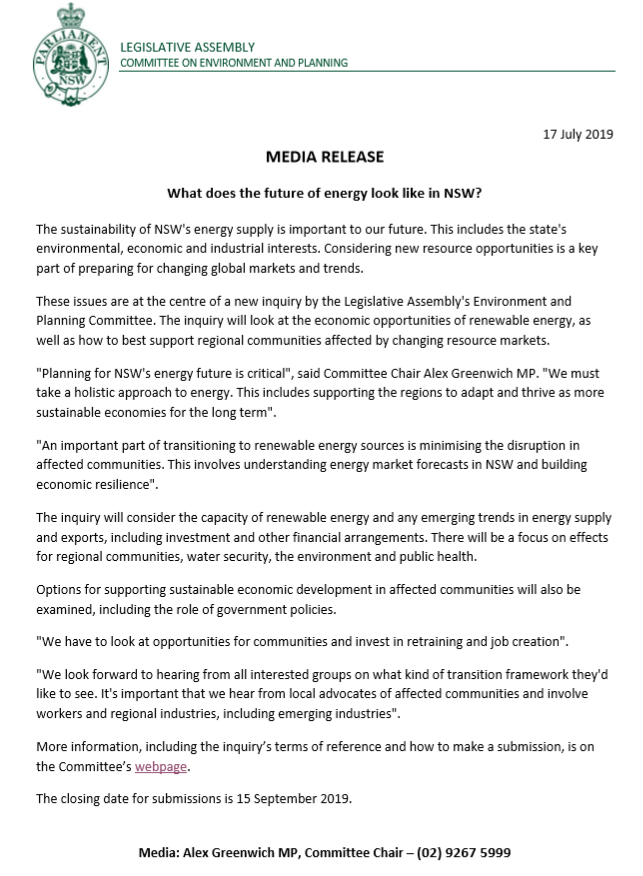
On 17 July 2019, the NSW Legislative Assembly Committee on Environment and Planning announced there would be an inquiry into and report on the sustainability of energy supply and resources in NSW, and the impact on regional communities. See link below

https://www.parliament.nsw.gov.au/committees/inquiries/Pages/inquiry-details.aspx?pk=2542#tab-termsofreference

There are three points about this that immediately come to mind.

1. Who are the members of the committee?

Chair: Alex Greenwich MP, Independent, Member for Sydney
Deputy Chair: Felicity Wilson MP, Liberal, Member for North Shore
Members: Anoulack Chanthivong MP, ALP, Member for Macquarie
Fields
James Griffin MP, Liberal, Member for Manly
Nathaniel Smith MP, Liberal, Member for Wollondilly

If this inquiry is about supporting regional communities, where is the representation of MP’s from regional NSW?

What about the hundreds of submissions already lodged for all
the renewable energy projects?
Hasn’t the NSW Department of Planning been receiving submissions about the numerous renewable energy projects across NSW for the past decade? Has anyone taken any notice of those submissions? Hopefully the Committee will start by reading the numerous objections by local communities that have already been lodged.

What is the likelihood of any of the people who have provided submission to projects:
a. knowing this is happening; and
b. has the time and inclination to do this again, when many believe that no one listened to them in the first place.

The Sutton Solar Action Group (SSAG) intends the make a submission. All development in NSW has to meet the three requirements of economical sustainable development which is the effective integration of economic, social and environmental considerations in the decision-making process. SSAG believes the renewable energy development assessment process is no different and will make a submission outlining the faults/flaws that we have discovered during the review of the Springdale EIS.


Below is a copy of the Media Release

Feedback on the Large Scale Solar Energy Forum – Wagga Wagga, 3 July 2019

On Wednesday evening (3 July) we attended the above forum hosted by the NSW Farmers.

The Executive Director for Planning and Assessments from the NSW Dept of Planning David Kitto and Nicole Brewer were present and Mr Kitto made a presentation and took many questions from the floor. 

It was a fairly robust meeting with over 120 people present, all of whom were opposed to various large-scale solar developments that have been either built or in the planning stages near their properties. 

When we identified who we were and our issue was Springdale, Mr Kitto made it clear that he was well aware of this development and that there was a significant number of objectors. We asked a number of questions about Springdale i.e that it was 309 days since submissions closed and there has been no contact from Renew Estate, and why the developers have no time constraints to lodge the response to submissions?  We also complained about the serious lack of consultation by the developer.  Not surprisingly the lack of consultation by developers was raised time and time again in questions.  It should be noted that one group raising concerns was with another Renew development, Bomen, which is just north of Wagga.  Again, not surprisingly, was Renew’s lack of consultation with affected residents.  It should be noted, that that development has been constructed and has already been sold by Renew to another renewable energy company.

We also got to speak directly to Mr Kitto and Ms Brewer after the meeting.  Suffice to say, they are now well aware of our numerous concerns, and we told them in no uncertain terms what we thought about the poor quality of the EIS and the many errors contained in it.

Many of the questions from the floor are relevant to our group and once the NSW Farmers have finalised the summary of the meetings we anticipate being able to forward this to you. There was also Forum’s in Dubbo and Armidale, so we expect the summary will include all three.

One issue that was raised from the floor was about decommissioning and removal of infrastructure.  We aren’t sure that ‘host’ landholders would be fully informed about who is responsible for removal of the solar farm infrastructure. Mr Kitto said that the government had thought about asking for surety of some kind from the developer to ensure there is money to pay for removal, but as the government is not a party to the development they have no part of the contract.  It is a private matter between the landowner and the developer.

All responsibility for decommissioning & rehabilitating the land when the development has come to its end (whether it be 5, 15, 30, 60 or 100 years) rests with the owner of the facility at that time. Should the owner decide not to remove the items OR goes into liquidation and cannot undertake the task (which many speculate will happen due to the substantial costs of decommissioning & rehabilitation for no financial return), the NSW Government will not get involved because it has no part to play.

To make it worse, the ‘host’ landholder would not be legally able to remove any of the infrastructure either even though its on his/her land, as it is not legally theirs and may become the subject of court action between the owners and their financiers, which could even be overseas banks.  So the infrastructure could lay dormant on the land for many years and render the land unsellable and unusable until the matter is resolved.  I wonder if anyone ever explained that to the Springdale landholder before he signed up?

All in all its was a good opportunity to get our faces and issues in front of the head of planning in NSW. When we receive a meeting summary we will send out and place on the website.
NSW Farmers Association is holding a Large-scale Solar Forum in Wagga on 3 July

Here’s an opportunity to put your questions to the policy makers i.e the Department of Planning and Environment and representatives from the Energy.

https://www.facebook.com/events/2566780463335026/

NSW Farmers, in conjunction with the Department of Planning and Environment, will be hosting a forum in Dubbo to focus on community concerns surrounding large scale solar. The forums will give members and their guests an opportunity to raise their concerns and have their questions answered by government and industry representatives.

This is a particularly important chance to provide landholder and broader agricultural perspectives to government as they continue to develop their strategies for future energy generation and transmission.

The forum will start at 6:30pm and end at approximately 8:30pm with light refreshments to be provided upon conclusion.

Several branches have organised buses to drive members to and from this event in Wagga Wagga. Get in contact with your branch or Regional Service Manager to find out whether there is a bus organised for your area.

For further information contact:

Julia Jelbart
Policy Advisor- Environment
0477489713 | jelbartj@nswfarmers.org.au

Daniel Brear
Regional Services Manager – South West
0427 773 495 | breard@nswfarmers.org.au

Only one project in 20 can connect

NSW Department of Planning and Environment released the NSW Transmission Infrastructure Strategy in December 2018, which said “… for every 20 projects looking to connect to the grid only one can…, and this “working with industry experts and energy stakeholders to accelerate the development of new interconnector projects, priority Energy Zones and those actions that have the greatest potential to improve cost-effective, private sector‑led delivery of a reliable, secure energy supply“…


The plight of the Superb Parrot is a favourite of Greening Australia

It appears that Greening Australia considers the plight of the Superb Parrot important enough to warrant three posts so close together.

What is regrettable is that the NSW Office of Environment and Heritage (OEH), who have responsibility for the Saving our Species strategy, only recommend
developers leave trees with hollows for the Superb Parrot.

These are OEH’S words in response to the Springdale EIS, …”If this is not the desired option for the proponent, they can assume loss … of breeding habitat, and look for offsetsOR undertake surveys in the breeding season to determine whether these trees represent breeding habitat or not“. Which basically says, if the developer doesn’t think the trees are being used for breeding, than the trees can be removed, without any penalty. Bad luck for any species that needs a hollow for breeding.