Since our last post the SSAG has been able to read the entire Response to Submissions (RTS) as have many other members of the community. We all seem to be in agreeance about the sufficiency of the RTS. It beggars belief that it has taken almost two years to lodge this document which is basically just a rehash of the EIS, and devoid of any consideration of the community issues, despite RES’s claim: …’The issues raised in each submission were then extracted, summarised, and collated … and responses have been provided that are proportionate to the relevance of the issue.’ Clearly the responses are based on RES’s point of view, not ours!
RES’s whole attitude towards this community’s concerns about visual impacts can be summed up by a comment in the Land Use Conflict Risk Assessment in the RTS which says: ‘This potential conflict is however expected to ease over time as screening vegetation matures and people become accustomed to the development.’
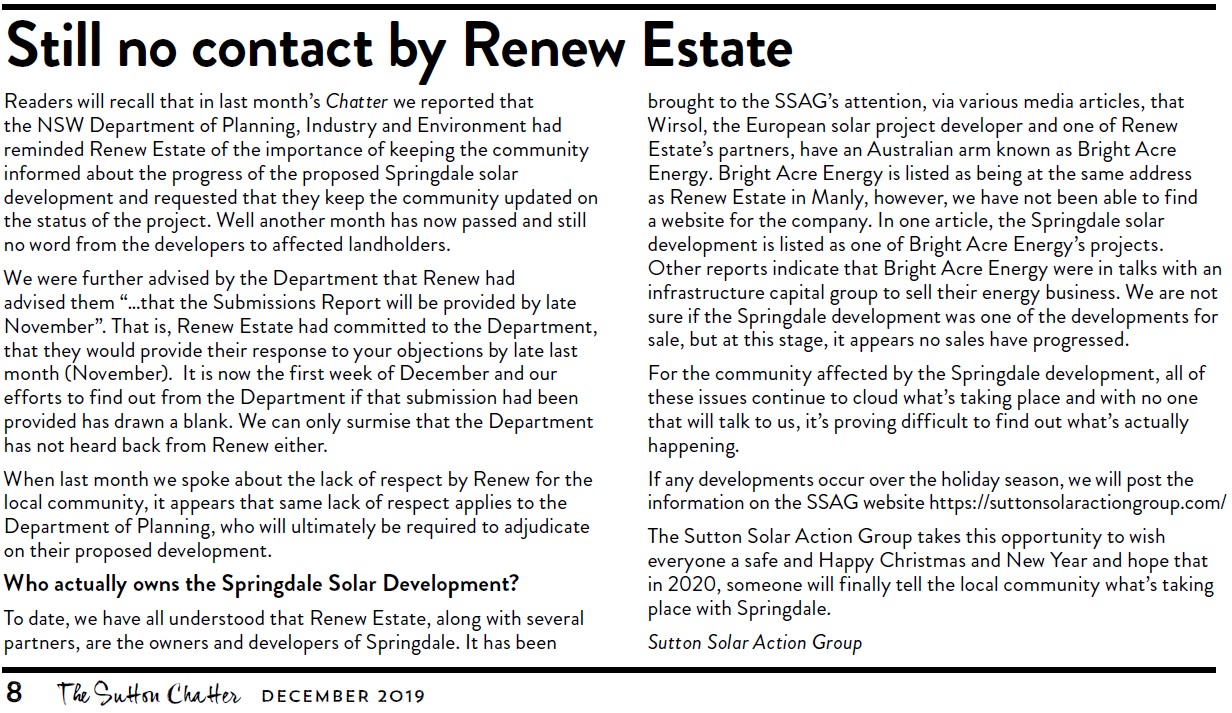
RES confirmed what we suspected all along that Renew Estate (Renew) were not genuine about developing the project. They were expecting that there would be minimal opposition and approval would be straightforward. We believe it is no coincidence that once Renew saw how strong the community opposition was to the project it became too hard to deal with, so was ‘put on hold‘ at the end of 2018. RES stated this on 7 April 2020 when they informed us that they were the new developers and again in the first paragraph of the RTS.
Renew repeatedly told the Department of Planning, Industry and Environment (DPIE) who in turn told the SSAG that Renew still had to finalise some ‘additional archaeological studies’ before the RTS could be lodged. Interestingly the RTS contained no ‘additional archaeological studies’ and makes reference to an agreement between the Department and AECOM (the consultant who prepared the EIS/RTS) in December 2018 relating to these studies. The SSAG is seeking clarification from the DPIE on the contents of the agreement. What is deplorable is the degree of anguish this unnecessary delay has caused the Sutton community, and to add insult to injury, Renew just passed it on like a ‘hot potato‘.
In a previous post we mentioned that we had written to Minister Stokes again, asking for an opportunity to put forward updates on the issues that the Sutton community had included in their submissions.
On 26 June 2020, representatives from the SSAG had the opportunity to do so by participating in a teleconference with the Executive Director of the DPIE and other DPIE representatives.
In preparation for this meeting the SSAG read all the submissions from Sutton residents and compiled a list of the issues raised so that we would have an understanding of what this community considers important. Overall there are 43 issues which were then grouped into 5 topic areas. In order there is 1. Traffic/road safety (incl the heavy vehicle route), 2. Visual impacts 3. Site suitability 4. Biodiversity 5. Socio-economic impacts.
Here is a very brief summary of the information the SSAG shared with the DPIE in response to the RTS:
1. Traffic/road safety – the proposed mitigation to deal with the increased traffic is farcical, aspirational and is in no way enforceable. SSAG traffic survey shows a very different scenario to that of the EIS.
2. Visual impacts – developers were requested to expand the visual impact studies, they added just two more properties, no more. The RTS included an additional measure to mitigate visual impacts, which is, if it can’t be mitigated at the source, it may be reduced at the ‘receptor’. Hands up those who would like a barrier put on your property to hide the ugliness? This is preposterous and would be a nightmare to implement let alone maintain.
3. Site suitability – The SSAG reiterated that the proposed development is not compatible with any of the planning strategies for the area and also reminded the DPIE that the Office of Environment and Heritage stated this area is critical to maintain biodiversity connections between Mulligans Flat Nature Reserve and Goorooyarroo with other regions of NSW.
Inconsistent with the NSW proposed renewable energy zones (REZ’s). Technically a solar facility will generate energy anywhere the sun shines, but that doesn’t mean they should be put just anywhere. There are many factors that determine the best locations for large-scale renewable energy generation, and this area is not one of them. A number of different studies have been conducted over the past decade and have consistently shown the same three (3) regions which are the New England, Central West and South West as the better areas for large-scale renewable energy (both wind and solar) generation in NSW.
On 17 December 2010, AECOM provided the NSW Department of Environment, Climate Change and Water (DECCW) with their ‘Pre-feasibility Study for a Solar Power Precinct.’ One objective of the study was to: …’Determine the feasibility of large scale solar projects in NSW and to test the concept that the co-location of solar plants into a precinct to facilitate sharing of infrastructure may expedite financial viability.‘…
16 locations across NSW were chosen for the study and five (5) areas which includes the three (3) regions above were chosen for further studies. One of the 16 was the Lake George region which is only 14 kms to the east and was ranked 15th for three (3) different types of PV technology, and 16th for generation potential. What does that say? There are far better areas of NSW for large-scale solar energy generation, despite the claims that AECOM made in the EIS ‘this region has among the best resources in the world‘.
If AECOM knew all this information as far back as 2010 why didn’t they advise their client Renew that there were much better locations for large-scale solar development such as the areas identified by them in their report. These same areas have subsequently been supported by the NSW Government’s submissions to AEMO’s 2018 ISP and by DNV-GL who also provided advice to AEMO for the 2018 ISP. In May of this year the DPIE called for registrations of interest in the ‘pilot’ Central West REZ.
4. Biodiversity – There are both NSW and Commonwealth guidelines to determine if a development will have a significant impact (SI) on threatened species. The Springdale Biodiversity Assessment Report (BDAR) for the Golden Sun Moth doesn’t meet either of these SI guidelines.
Included in these SI guidelines there is also a threshold at which it has been determined that there will be a SI, the BDAR exceeds the impact thresholds for the Golden Sun Moth. Why have these guidelines if they aren’t going to be applied?
These same SI guidelines state that it is not enough just to have mitigation. Only mitigation measures that have proven to be successful in similar situations should be considered. There is not one proven mitigation measure included in the EIS/RTS. Again, why have the guidelines if they aren’t going to be used. Little wonder Australia is facing a faunal extinction crisis!
5. Socio-economic – The spatial and economic distributive inequity of this project. The economic benefits will go to RES and just one landholder who live geographically distant from the project and will not to be impacted. Whereas those living in closest proximity to the proposed development will bear the full impact for 35 years and will not receive any economic benefit.
A community fund of $100,000 has been proposed. If you break that down by population of the area over the proposed lifespan of the project this is what the developer thinks is adequate consideration for each person:
$100,000/1660 (ABS pop) = $60.24 each
OR $1.72 each year for 35 years
whereas,
According to the LDC Infrastructure website, ‘Solar lease rates are almost always based on both the quality and quantity of the land assigned to the lease.
On average, solar rental fees will fall somewhere around $700-$3000 an acre.’ https://ldcinfrastructure.com.au/company/
Based on the approximately 850 acre Springdale site the landholder stands to make potentially many millions of dollars.
Like everyone in the community the SSAG is waiting on the DPIE to complete their assessment of the Springdale project which is then provided to the Independent Planning Commission who will conduct hearings (another opportunity for the community to voice their objections) before making the final determination on the Springdale project.
 Sutton Solar Action Group
You must be logged in to post a comment.